

Microsoft 365 had three major outages in 2026, and each one took security and compliance tools like Purview DLP and Defender down along with email. None were attacks; they were ordinary bugs in shared infrastructure. That matters for AI security: if the controls that govern AI tools run on the same platform, an outage that has nothing to do with AI can switch off AI oversight while browser-based assistants and coding agents keep running. Decide in advance what happens when AI oversight degrades, and keep enforcement somewhere that doesn't share a failure domain with the rest of your stack.
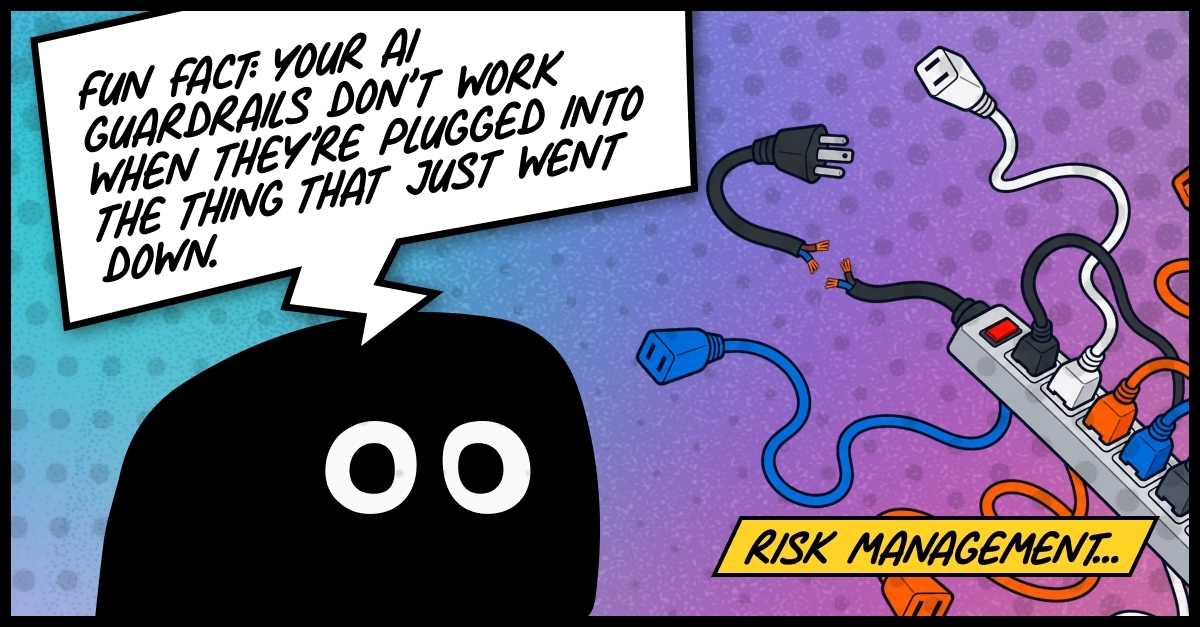
It's late afternoon on the East Coast on Thursday, November 12. Someone on your finance team pastes next quarter's forecast into a browser-based AI assistant. That assistant isn't part of Microsoft's outage, so it keeps answering. Microsoft Purview is. By then, Microsoft's status updates had added Purview to the incident, with DLP, auto-labeling, and data classification among the affected functions. Before the night was out, Microsoft was also warning that Defender for Office 365 experiences relying on Purview DLP and Information Protection signals might see “delayed or failed policy evaluation and governance enforcement.”
Whether your particular policy would have fired at that moment depends on how it's deployed. That uncertainty is the point. The forecast is hypothetical. The outage isn't, and it's at least the third time this year that Microsoft 365's security and compliance tools have been caught up in a failure that started somewhere else entirely. If your AI oversight shares a platform with systems that have nothing to do with AI, an email outage can become an AI security outage.
Three Outages, One Pattern
Microsoft 365 has had at least three multiservice incidents in 2026 in which the security and compliance consoles were affected alongside email. None was a cyberattack, and each had a different root cause:
- January 22: Overloaded infrastructure in North America during maintenance disrupted access to the Purview, Defender XDR, and Microsoft 365 admin center portals for roughly ten hours.
- August 31: A code update to Microsoft's certificate management automation let a subset of authentication certificates expire unnoticed. Purview, Defender XDR, the admin center, and Copilot were all on the impacted list for an incident that wasn't fully resolved until September 3.
- November 12: A defect in Microsoft's own networking gateway, introduced by a fix rolled out in July, left more than 80% of gateway servers unresponsive at the low point. Purview, Defender, the admin center, and Copilot were on the impact list again, during an incident that lasted about 24 hours.
Three root causes, one outcome. When the shared platform stumbled, the tools meant to watch over it stumbled with it.
November 12: When a Safety Feature Added Fuel
Microsoft's preliminary post-incident report, published November 15, reads like a case study in coupling. A fix rolled out to Microsoft 365's networking gateway servers in July carried a latent defect. Under certain load, an internal Windows process got stuck in lock contention and exhausted CPU and memory, a problem that's worse on newer machines with more cores. Microsoft's load testing tended to focus on weaker hardware with fewer cores, so the defect went unnoticed.
Then three ordinary things lined up. About fifteen hours before the outage, Teams traffic failed over to the primary gateway it shares with Exchange Online, which is normal resilience behavior. Nearly 14% of the gateway's capacity was already out of service because of an unrelated issue. And US peak traffic arrived. The defect triggered, unresponsive servers pushed their traffic onto healthy ones, and the failure spread across the fleet. Because the faulty code had been in production since July, the usual rollback tools couldn't undo it quickly.
Exchange Online took the worst of it, while services that could route around the gateway recovered sooner. Microsoft warned the problem could affect connectivity for users in any region, and according to its preliminary report, the impact ran from about 11:20am Eastern on November 12 to 11:10am the next day. Microsoft was explicit that it was a “technical issue not related to cyber or AI / agents.” Here's what else was on its impact list:
- Purview: authorization, auto-labeling, DLP, Communication Compliance, Information Protection, role-based access control, and data classification, with audit search and eDiscovery possibly affected too.
- Defender: Defender for Office 365 experiences that rely on Purview DLP and Information Protection signals could see delayed or failed policy evaluation and enforcement. Earlier updates warned that Safe Links, Safe Attachments, Quarantine, and Threat Explorer might fail, and Defender XDR portal pages or solution tabs might not load.
- Admin centers: some Microsoft 365 admin center pages might not load.
- Copilot: Copilot Chat might not load or respond, and Copilot might be unable to access work data such as email, calendar, and files.
The failover that moved Teams onto the shared gateway did exactly what it was designed to do. It also put more of the platform's traffic on one path, and that extra load helped trigger a defect that was already waiting. That's the uncomfortable lesson of November 12: the mechanisms that make a consolidated platform resilient can also make its failures bigger.
August 31: The Certificate Nobody Was Watching
Ten weeks earlier, the cause was different and the shape was the same. A code update to Microsoft's certificate management system stopped distributing a subset of new authentication certificates, and a separate bug in expiration monitoring meant some weren't flagged before they expired. Microsoft says its identity service, Entra, wasn't impacted. Exchange Online took the worst of it, about 5% of the service by Microsoft's estimate, but the status updates spelled out the security impact: “Purview admins can't access the portal,” DLP and Communication Compliance policies could error on load, Defender saw “intermittent authorization failures across solutions,” and admins were warned they might be unable to reach Service Health, the place they'd normally go to find out what was happening.
To be clear about the limits: no one has reported a breach or an exploit during any of these windows. They were bugs, not attacks. That's exactly what makes them worth studying. Nobody had to attack anything for the oversight layer to falter.
Not a Microsoft Problem. A Coupling Problem.
It would be easy to read all this as a knock on one vendor. It isn't, and the public record shows why. On June 12, 2025, a policy update containing blank fields replicated worldwide into Google Cloud's Service Control, the system that authorizes API requests, and crashed it in every region. Identity and Access Management was on the impacted list, along with dozens of Google Cloud and Workspace products. On October 20, 2025, a latent race condition in AWS's automated DNS management for DynamoDB left an empty DNS record in its US-East-1 region, and the failure cascaded into EC2, Lambda, and load balancing for hours.
Some of the largest platforms in the world, each brought down by a defect in a system at its core. In every case, the blast radius was set by what shared the same plane, not by the brand on the invoice.
Consolidating onto one provider can still be a perfectly defensible trade-off: fewer integrations, simpler operations, a single vendor relationship. The point isn't to undo it. It's to make that trade-off on purpose, knowing which controls go dark when the platform does.
Concentration Risk Isn't Really About Uptime
The lesson of 2026 isn't that Outlook was down. It's concentration risk. When productivity, security, and compliance tooling all sit behind one provider's shared infrastructure, the organization inherits that provider's failure modes across the whole stack. A simple rule of thumb: anything that depends on the same failing component goes down with it, whoever built it. In August that component was internal service authentication. In November it was a networking gateway. Neither was the identity provider, and neither had anything to do with security. The security consoles faltered because they live inside the platform.
Consolidating security tooling onto the same platform as email is efficient, and it also means security can go quiet on the same day email does. If a DLP policy can't load or evaluate during an outage, it can't enforce during exactly the kind of incident it exists for, and on November 12 DLP was on Microsoft's list of affected Purview services. The question worth asking isn't “was Outlook down.” It's “which of my controls went quiet at the same time, and did I know that going in.”
What This Means for AI Security
Here's where it gets specific to AI. Microsoft 365 is also where Copilot lives, and the controls organizations use to govern it, including Purview DLP for Copilot, sensitivity labels, audit, and eDiscovery, sit on the same shared platform as Exchange and Defender.
Copilot was on the impacted list in both August and November. You could take some comfort in that: if the AI degrades along with its oversight, at least they fail together. But that isn't a control. It's a coincidence of architecture. Outages don't take every component down evenly or bring them back in the same order. On November 12, services that could route around the broken gateway recovered sooner than those that couldn't. When oversight shares a failure domain with what it governs, you don't get to choose which half comes back first.
And Copilot isn't the only AI in the building. Browser-based assistants and coding agents sit entirely outside Microsoft 365, so an M365 outage does nothing to slow them down. If the policies meant to govern them depend on the same platform that fails, those tools keep running while the oversight doesn't. Microsoft said November 12 had nothing to do with AI. For AI governance, that's precisely the problem: an outage that has nothing to do with AI can still take AI oversight down with it.
What Actually Changes: Deciding in Advance What “Degraded” Means for AI Oversight
Most security programs have a continuity plan for email and collaboration. Very few have one for AI oversight. The question to answer before the next outage, not during it: if your AI governance layer is degraded for a day, as Microsoft 365's was on November 12, is that acceptable? Who owns the call, what's the manual fallback, and which AI usage gets paused until oversight is back? Or does that gap alone mean oversight needs to live somewhere that doesn't share a failure domain with the platforms around it in the first place?
For most organizations, the honest answer is that no one has asked. None of this year's outages caused an AI incident that anyone has reported. They exposed a gap that was already there: AI oversight built on the same platform as everything else has a single point of failure, and it usually isn't discovered until the day it matters.
Where MagicMirror Fits
This is the architectural bet behind local-first AI security for agents and browsers. Classification and enforcement decisions happen on-device, through a pool of small models running locally, not by calling out to the customer's identity provider or productivity platform to ask permission to act. Whether Microsoft 365, Entra, or any other identity and productivity stack is fully available, degraded, or in the middle of a certificate incident or a gateway failure has no bearing on whether a prompt gets classified or a tool call gets evaluated before it executes.
On the browser side, PII and payment card data in prompts and uploaded files are tokenized before they reach the model, with the real values restored in the response. On the agent and API side, the MCP proxy and API proxy classify tool calls and API traffic locally, then block sensitive content before it leaves the device, based on policy. Neither path depends on a shared control plane staying up. The AI tool being governed and the thing governing it were built not to share a failure domain, by design, not as a fix applied after an outage made the gap visible.
That's not a claim that any single deployment is immune to every possible failure. It's a narrower, verifiable design decision: the classification and AI policy enforcement decision itself doesn't require a live call to the customer's identity or productivity platform, so an outage in that platform doesn't take AI oversight down with it.
What to Do Now
Start with the question this piece opened with, applied to your own environment. Five questions worth taking into your next staff meeting:
- Which of our AI controls, such as DLP for AI, prompt and upload monitoring, audit trails, and approval workflows, depend on the same platform as our email and collaboration tools, or as the AI tools they govern?
- If that platform went down for a day, as Microsoft 365 did on November 12, which AI tools would keep working, and which of their guardrails wouldn't?
- What's our manual fallback for AI oversight during an outage, and who owns it?
- Who can make the call to pause AI usage, and what triggers it?
- When did we last test any of this?
If the answer to the first question is “the same platform,” that's the gap, and it's worth knowing before an outage finds it for you. MagicMirror's Shadow AI Discovery is a free way to see what's actually running in your environment today, independent of whether any single vendor's platform is having a good day. Prefer to see the on-device classification working first? Book a demo.
- Microsoft 365 has had at least three multiservice outages in 2026, on January 22, August 31 and November 12. Each time, Purview, Defender and the admin center were affected alongside email. None was a cyberattack.
- November 12 was the longest, at about 24 hours. A latent defect from a July gateway fix, triggered partly by a routine Teams failover onto a gateway shared with Exchange, left more than 80% of gateway servers unresponsive. Purview DLP, Information Protection and Copilot were all on Microsoft's impact list.
- It's a coupling problem, not a Microsoft problem. Google Cloud in June 2025 and AWS in October 2025 showed the same pattern: a defect in one shared core system cascades into everything that depends on it.
- Anything that depends on the failing component goes down with it. In 2026 those components were internal service authentication and a networking gateway, not the identity provider, and neither had anything to do with security.
- AI security built into a productivity platform shares that platform's outages. Meanwhile, browser-based AI assistants and coding agents outside the platform keep running whether or not their oversight does.
- Plan for degraded AI oversight before the next outage. Decide the fallback, the owner and which AI usage gets paused, and keep AI data security controls outside the failure domain of the platforms around them.
Govern AI where it's used, not after the damage is done.
Or talk to our AI security experts → sales@magicmirrorsecurity.com


