

AI use inside companies grew faster in 2026 than the controls around it, and attackers noticed. AI-driven attacks rose 56% this year and added roughly $1 million to the average breach, according to IBM's Cost of a Data Breach Report 2026. Over the same period, two-thirds of departments started running AI agents, per a Wharton and GBK Collective study of 1,416 U.S. leaders and employees.
The usual October move is to write the fix into next year's budget. This year, that is the expensive choice. Your exposure is not scheduled for January. Every week between now and a 2027 project kickoff is another week of prompts, uploads and agent tool calls that nobody is watching, during the busiest stretch of the year.
This post covers what changed in 2026, why governance fell behind, what it costs when AI goes ungoverned, and what security teams can put in place before December 31.
The three numbers that defined 2026
Usage went up, autonomy went up and attack volume went up. Oversight stayed flat or slipped.

Why governance fell behind
IBM's own read is blunt: AI-related breaches came mostly from structural gaps, such as compromised APIs and connected apps, or cloud misconfigurations. These are governance failures, not model failures. Four patterns explain how the gap opened.
Approvals loosened as use grew. The share of organizations with strict approval for AI deployments fell to 38%, from 45%.
Governance and security work in separate lanes. Only 19% of organizations coordinate the two.
Access controls never caught up. Of organizations with an AI-related breach, 92% lacked proper AI access controls. Only 40% apply access controls to AI models and data at all.
Leaders think the organization is readier than it is. Among managers, 78% say employees are adequately trained on AI; 56% of employees agree. Accountability for agents is also unsettled: Wharton found no consensus on who answers when an agent makes a mistake, and some respondents said nobody clearly does.
What it costs a firm like yours
Financial services remained the second-most-expensive industry for a breach in 2026, and costs rose across the board.
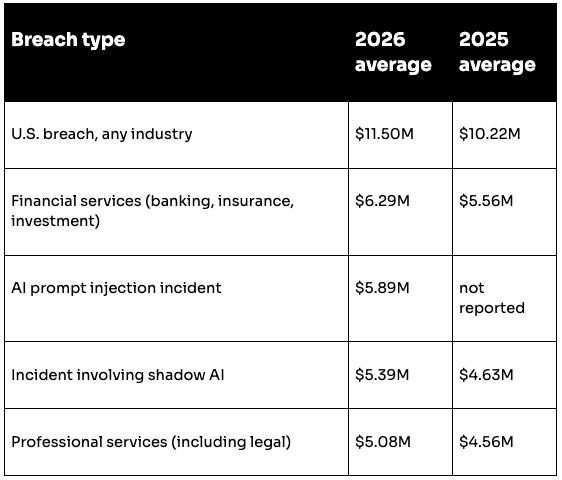
Two details matter more than the averages for a regulated firm. In about one in five shadow AI incidents, the organization paid a regulatory fine. And IBM found that noncompliance with regulations added about $201,000 to breach costs, the same as lacking visibility into shadow IT.
Prompt injection is the AI threat to watch: it grew to 25% of AI-related breaches, from 17%, and averaged $5.89M per incident. It matters more to most firms than IBM's headline $6M figure for model inversion, which only applies if you train or host your own models.
One caveat: these are averages from 602 breached organizations, pulled up by large U.S. figures. Treat them as directional, not as a forecast for your firm.
Why the window is this quarter, not January
Waiting for the 2027 budget means carrying this exposure through the riskiest stretch of the year, with nothing to show for it when planning starts.
Breaches outlast quarters. The average breach took 247 days to identify and contain in 2026, the first rise in five years. One that starts in November is, on average, still open next July.
Your regulators measure the calendar year. NYDFS Part 500 covered entities, for example, certify compliance for the prior calendar year each April. Unmonitored AI use in 2026 sits inside the year you will be certifying.
Year-end raises the load and thins the watch. Close, client deadlines and holiday coverage mean more AI use under time pressure and fewer people reviewing it.
The threat timeline compressed mid-year. After frontier models showed they could find high-severity vulnerabilities at scale, 85% of breached organizations told IBM they plan to raise security spending, up from 64%. IBM's point is that organizations are now acting on expected risk rather than waiting for an incident.
You plan better with your own data. A discovery effort that starts in November reports before the holidays, so 2027 planning starts from what is actually running in your environment, not from industry averages.
What to do before December 31
A team of one to five people can finish the first three steps in a few weeks; the rest are policy decisions that need an owner, not a project.
- Inventory every AI tool, agent, plugin and MCP server in use, across every team. Agents are no longer just engineering tools. Sales and marketing teams now connect agents, plugins and MCP servers to automate prospecting and pipeline work, often with their own credentials. Include those, plus personal accounts and coding agents, not just the approved list.
- Write a one-page AI policy organized by data type and account type. Say which data can go into which tools, and treat a personal login differently from corporate SSO.
- Protect data inside prompts and uploads instead of banning tools. Blanket blocks push people to personal accounts, which is how shadow AI grows.
- Scope the credentials agents use. Use short-lived, least-privilege keys and no shared secrets. Only 46% of organizations secure the non-human identities in their AI workflows.
- Require human approval for agent write actions that touch production systems or client data.
- Name an owner for every agent, so "who is accountable" has an answer before an examiner or client asks.
- Route AI events into your existing incident process, so an AI incident starts your notification assessment the way any other incident does.
Visibility is also where the AI returns are
The organizations getting real value from AI are the ones that can see how it is used. That makes this spend easier to defend than a pure risk line item.
In the Wharton study, 80% of managers and above reported positive AI returns, but only 28% called them strongly positive. Departments with strong returns were more likely to monitor AI use (92% vs. 74%) and to have significantly changed their workflows (84% vs. 69%). On the security side, IBM found that organizations using security AI and automation extensively saved $1.93M per breach and closed breaches 65 days faster.
These are correlations, not proof that monitoring causes returns. But they point the same way. The visibility that tells your security team what is leaving the building also tells your COO which teams are getting value from AI and which are not.
Where MagicMirror fits
MagicMirror covers checklist steps 1 through 3 across browser AI tools and the AI agents on employee devices, without adding headcount to run it.
Find every agent and MCP server. See which AI agents are installed across your workforce, from engineering to sales, and every MCP server each employee has connected. Supported agents include Claude Code, Claude Cowork, Claude Desktop, ChatGPT Desktop, Codex CLI, Cursor and Claude Code in VS Code. In the browser, coverage spans 1,000+ AI tools.
Know the risk, and keep knowing it. Every agent and MCP server, local servers included, is risk-scored, with known CVEs factored in. Inventories are rescanned nightly for newly disclosed vulnerabilities and changes.
Control who uses what. Set which agents each department can use, and require corporate accounts instead of personal logins.
Protect data in browser AI tools. Sensitive values in prompts and uploaded files are replaced with synthetic tokens before they reach the model, then restored in the response.
Block risky agent activity and audit every session. Block MCP servers by risk score or publisher, block specific types of tool calls, and block PII, intellectual property and threats such as tool poisoning and malicious tools.
No sensitive data leaves the device. Classification runs on small on-device models. Only hashed metadata syncs to our servers.
Adoption data for the business. The same deployment reports AI adoption and token usage by team.
Marv secures what happens on employee devices. It works alongside your identity and cloud controls, not in place of them.
Start before year-end. Our free 30-day discovery program inventories and risk-scores the AI tools, agents and MCP servers running in your environment. Start by mid-November and you will have your own numbers before 2027 planning begins.
Sources
- IBM, Cost of a Data Breach Report 2026
- WSJ CIO Journal, AI Business Use Rises Despite Growing Concern (Oct. 13, 2026), summarizing the Wharton / GBK Collective study


